


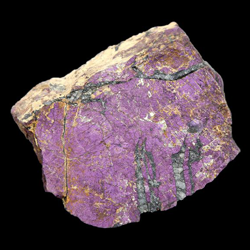
 HETEROSITE
HISTORY, NAME, LOCALITIES: Heterosite, pronounced hett-er-OSE-ite, was recognized as a mineral species in 1826. Its name stems from the Greek heteros, meaning “other” or “’different,” because it was the second manganese-containing mineral to be discovered at the type locality. Collecting areas are found in Namibia, Australia, Austria, Germany, France, Italy, Brazil, Spain, and the United States (Maine, New Hampshire, Connecticut, Massachusetts, South Dakota).
MINERALOGY, PROPERTIES, OCCURRENCE: Heterosite [iron phosphate, FePO4] crystallizes in the orthorhombic system, usually in massive or granular form or as coatings and crusts. It has a Mohs hardness of 4.0-4.5, good cleavage in one direction, a silky luster, and a specific gravity of 3.4. Because heterosite participates in a solid-solution series with purpurite (manganese oxide), it always contains some manganese. Heterosite is an opaque mineral that is usually purplish-brown in color, but may also be greenish brown or dark, pinkish-brown. It is a rare, secondary mineral that forms from the oxidation of triphylite (lithium iron phosphate) in granite pegmatites.
METAPHYSICAL PROPERTIES, LORE, USES: The metaphysical properties of heterosite are similar to those of purpurite. It is thought to enable one to speak with confidence, promote spirituality and inner confidence, enhance insight and understanding, and help avoid destructive or self-limiting patterns. Heterosite is not used in jewelry and has no technological uses.
COLLECTORS’ INFORMATION: Heterosite is collected for its rarity and unusual color.

 Axinite #10
  Axinite #8