


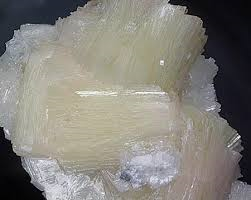
 BAVENITE
HISTORY, NAME, LOCALITIES: Bavenite, pronounced bah-VEEN-ite, was identified as a mineral species in 1901. It is named for its type locality in Baveno, Piedmonte, Italy. Notable collecting localities are in Italy, Afghanistan, Australia, Austria, China, Germany, Norway, Russia, Sweden, Switzerland, and the United States (California, North Carolina, New Hampshire, Wisconsin, Virginia).
MINERALOGY, PROPERTIES, OCCURRENCE: Bavenite [basic calcium beryllium aluminum oxysilicate, Ca4Be2Al2Si9O26(OH)2], crystallizes in the orthorhombic system, usually as radial sprays of acicular crystals, and less often as then tabs. It is an uncommon mineral with a Mohs hardness of 5.5, perfect cleavage in one direction, uneven fracture, vitreous-to-pearly luster, and specific gravity of 2.7. It is transparent to translucent and usually colorless to white, but impurities sometimes create very pale hues of pink, green or brown. Bavenite, which forms from the chemical alteration of beryl, occurs primarily as drusy coatings within mariolitic cavities in beryllium-rich, granite pegmatites.
METAPHYSICAL PROPERTIES, LORE, USES: Modern metaphysical practitioners believe that bavenite can alleviate disorders of speech, hearing, touch, smell, and sight, while enhancing general physical well-being and aligning mental energies. Bavenite is too rare to have any technological or gemstone uses.
COLLECTORS’ INFORMATION: Bavanite is collected for its rarity, complex chemistry, delicate sprays of colorless, acicular crystals, and frequent association with other rare, pegmatite minerals.

 Axinite #10
  Axinite #8