


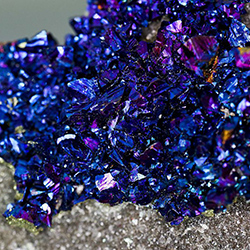
 CHALCOPYRITE
HISTORY, NAME, LOCALITIES: Chalcopyrite, pronounced kal-coe-PIE-rite, has been known since antiquity and has variously served as an ore of copper, iron, and sulfur. Its name is derived from the Greek words chalco, meaning “copper,” and pyr, “fire,” alluding to its copper content and tendency to spark when struck with iron or flint. Chalcopyrite is abundant and widely distributed. Notable collecting localities are found in Peru, England, Mexico, Australia, Bolivia, and the United States (Arizona, Colorado, Utah, Montana).
MINERALOGY, PROPERTIES, OCCURRENCE: Chalcopyrite [copper iron sulfide, CuFeS2] crystallizes in the tetragonal system as sharp, distinct, equant or wedge-shaped crystals. Chalcopyrite is opaque and has a bright metallic luster. Its color is brass-yellow to golden yellow; oxidation creates a dark tarnish that is often iridescent with hues of green, gold, and magenta. Chalcopyrite has a Mohs hardness of 3.5-4.0, poor cleavage in one direction, and a specific gravity of 4.1-4.3. It occurs in many mineralogical environments and reaches its highest levels of crystal development in hydrothermal-vein deposits where it is often associated with quartz.
METAPHYSICAL PROPERTIES, LORE, USES: Medieval physicians believed that when ingested, powdered chalcopyrite alleviated the symptoms of fevers, infections, and inflammations. According to modern metaphysical lore, chalcopyrite enhances perception, acts as a connective force in interactions with other cultures, and helps to remove energy blockages that interfere with meditation. Chalcopyrite is a major ore of copper.
COLLECTORS’ INFORMATION: Chalcopyrite is widely collected for its well-formed crystals, brassy-yellow color, metallic luster, and frequent associations with such other minerals as quartz.

 Axinite #10
  Axinite #8