


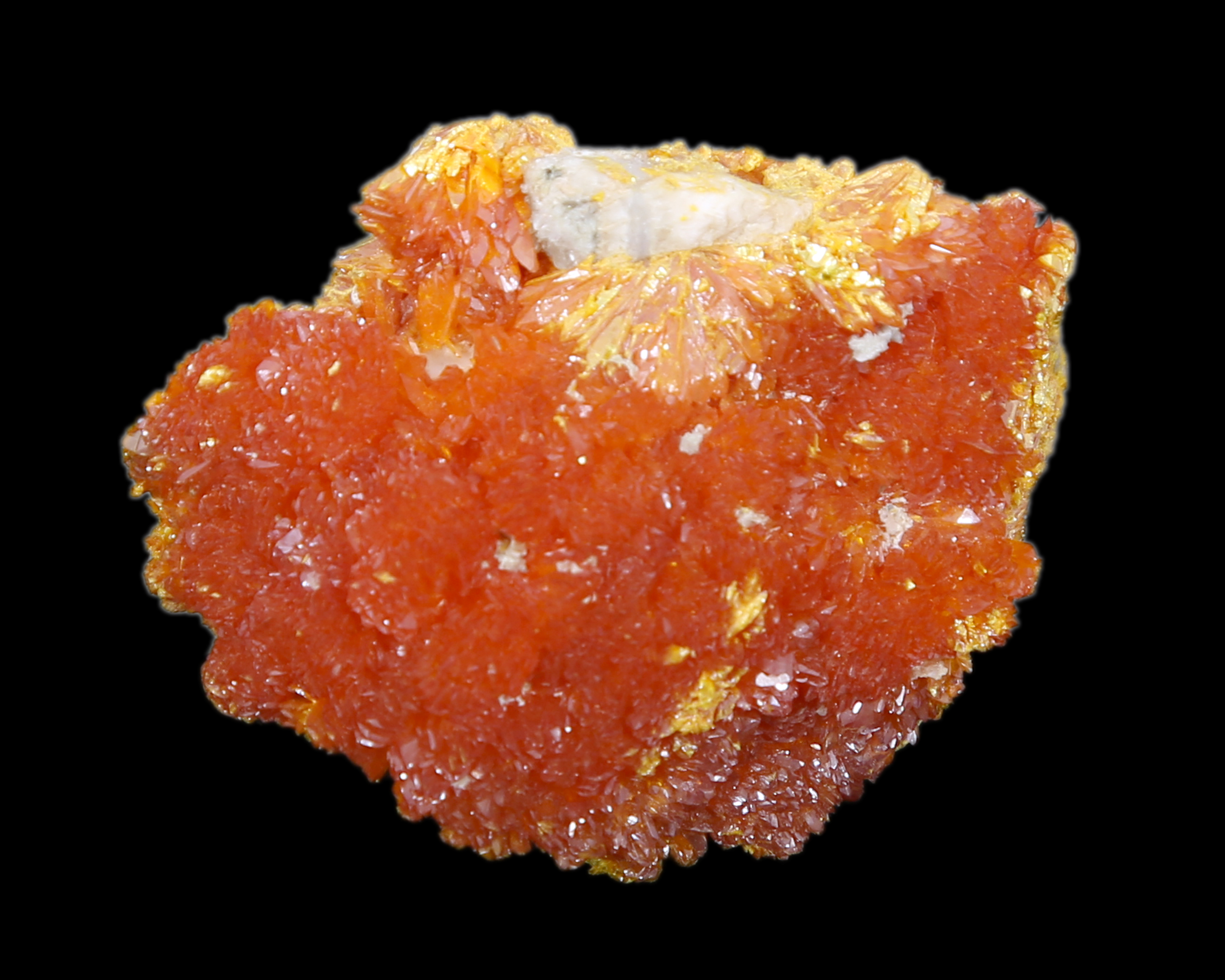
 ORPIMENT
HISTORY, NAME, LOCALITIES: Orpiment, pronounced ORE-puh-ment, has been known since antiquity when it was used as a yellow-orange pigment. Its name stems from the Latin auripigmentum, literally “gold-colored,” alluding to its yellow-orange colors. Notable collecting localities are found in Japan, Peru, Mexico, Canada, Italy, Russia, China, and the United States (Nevada, Utah).
MINERALOGY, PROPERTIES, OCCURRENCE: Orpiment [arsenic trisulfide, As2S3] crystallizes in the monoclinic system as short, small prisms, micaceous flakes, or granular aggregates or incrustations. It is transparent to translucent and its diagnostic yellow-orange colors are caused by its chemical composition and the light-absorption characteristics of its crystal lattice. It has a Mohs hardness of 1.5-2.0, perfect cleavage in one direction, a resinous luster, and a specific gravity of 3.4-3.5. Orpiment forms in low-temperature, hydrothermal veins from the alteration of realgar and native arsenic, and occurs in association with stibnite, realgar, cinnabar, and calcite.
METAPHYSICAL PROPERTIES, LORE, USES: Orpiment was formerly a yellow-orange pigment and, until the 1970s, an ore of arsenic. Until the early 20th century, orpiment was widely used in medicine as a purgative and to treat infections. According to current metaphysical beliefs, orpiment speeds recovery from disease and imparts direction and a sense of purpose to aid in the understanding and removal of mental blocks.
COLLECTORS’ INFORMATION: Orpiment is collected for its unusual chemistry; bright, yellow-orange colors; rarity of large crystals, and association with such colorful and uncommon minerals as realgar and cinnabar.

 Axinite #10
  Axinite #8