


 REALGAR
HISTORY, NAME, LOCALITIES: Realgar, pronounced ree-AL-gur, has been known since antiquity and was recognized as a mineral species in 1747. Its name stems from the Arabic rahj al-gāhr, meaning “powder of the mine.” Important collecting localities are found in Hungary, China, the Czech Republic, Russia, and the United States (Utah, Nevada).
MINERALOGY, PROPERTIES, OCCURRENCE: Realgar [antimony sulfide, As4S4] crystallizes in the monoclinic system, usually in granular, earthy, or incrusting forms; crystals, which are rare, have rounded, diamond-like cross sections. It has a Mohs hardness of 1.5-2.0, good cleavage in one direction, a resinous luster, and a specific gravity of 3.5-3.6. It is transparent to translucent with a diagnostic, deep-red-to-orange color that is caused by its essential elements and the light-absorption properties of its crystal lattice. Realgar occurs in low-temperature, hydrothermal veins and in volcanic fumaroles in association with such minerals as cinnabar, orpiment, and stibnite.
METAPHYSICAL PROPERTIES, LORE, USES: Realgar was used extensively as a rodent poison in medieval Europe. Until the early 20th century, realgar was widely used in medicine as a purgative and to treat infections. According to current metaphysical beliefs, realgar energizes the body, increases sexuality and fertility, and reveals both the positive and negative qualities of the inner soul. It is an important ore of arsenic and is used in certain pyrotechnic applications.
COLLECTORS’ INFORMATION: Realgar is collected for its bright, deep-red-to-orange colors, rarity of crystal form, and occurrence in composite specimens with such minerals as orpiment, cinnabar, and stibnite.

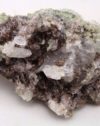 Axinite #10
 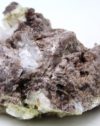 Axinite #8