


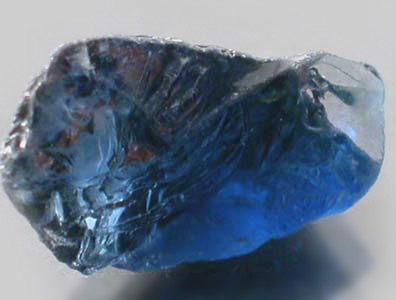
 CORUNDUM (var. SAPPHIRE)
HISTORY, NAME, LOCALITIES: The sapphire variety of corundum has been collected since antiquity. The name “corundum,” pronounced coh-RUN-dum, stems from kuruvinda, the ancient Sanskrit word for “ruby”; the word “sapphire,” pronounced SAH-fire, comes from the Latin sapphirus, meaning “blue” and referring to the classic sapphire color. Sapphire is collected in Myanmar, Tanzania, Sri Lanka, Thailand, Cambodia, India, Malawi, and the United States (Montana).
MINERALOGY, PROPERTIES, OCCURRENCE: Corundum [aluminum oxide, Al2O3] crystallizes in the hexagonal system as tapering or pyramidal prismatic crystals in rough and rounded barrel shapes, and as granular masses. It has a Mohs hardness of 9.0, no cleavage, and a specific gravity of 3.9-4.1. Corundum is transparent to translucent and occurs in all colors. The red gem variety is ruby; all other colors are sapphire. The classic blue color of sapphire is due to iron and titanium chromophores. Sapphire occurs in nepheline-syenite pegmatites, metamorphic rocks, and secondary alluvial deposits.
METAPHYSICAL PROPERTIES, LORE, USES: Sapphire, one of the first precious gemstones ever mined, is the birthstone for September. Metaphysical practitioners believe that sapphire is a stone of wisdom and learning that enhances the ability to see underlying truths, helps to access deeper levels of consciousness, and promotes order, structure, and discipline. Non-gem-quality sapphire crystals were once fashioned into jewel bearings for fine watch movements. Transparent blue sapphire, one of the classic precious gemstones, is faceted into very costly gems; translucent star sapphire is fashioned into cabochons.
COLLECTORS’ INFORMATION: Sapphire specimens are collected for their rarity, color, and interesting crystal habits.

 Axinite #10
  Axinite #8