


 STICHTITE
HISTORY, NAME, LOCALITIES: Stichtite was discovered in Tasmania, Australia, in 1891 and recognized as a new mineral species in 1914. It is named in honor of Australian mine manager Robert Carl Sticht. Stichtite is a rare mineral with only 14 known localities worldwide. Notable sources are in Australia, South Africa, Morocco, New Zealand, Russia, Canada, and the United States (New York).
MINERALOGY, PROPERTIES, OCCURRENCE: Stichtite [basic hydrous magnesium chromium carbonate, Mg6Cr2(CO3)(OH)16•4H2O], pronounced STICHT-ite, crystallizes in the hexagonal system (trigonal subsystem) usually as crust-like aggregates or radiating micaceous plates in matrix. It also occurs in massive or fibrous forms, bur rarely as macroscopic crystals. It has a Mohs hardness of 1.5-2.0, a waxy or greasy luster, and a specific gravity of 2.2. Its color, which ranges from lavender and lilac to light-violet, pink, and purple, is diagnostic. Stichtite forms when chromium-rich, serpentine-group rocks undergo low-temperature, long-term metamorphism that alters primary chromium-containing minerals into stichtite. Stichtite is usually found within a serpentine matrix.
METAPHYSICAL PROPERTIES; LORE, USES: Modern metaphysical practitioners believe that stichtite aids in controlling grief and emotional distress and promotes rational thought. Stichtite-in-serpentine, which offers the unusual contrast of purple stichtite against green serpentine, is a minor gemstone and has been fashioned into cabochons, beads, and small decorative objects. Stichtite has no technological uses.
COLLECTORS’ PROPERTIES: Stichtite is collected for its rarity, purple colors, and matrix association with green serpentine.

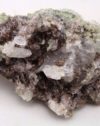 Axinite #10
 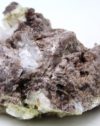 Axinite #8